CHAPTER TWO THE COMING OF THE RAILWAY
The railway
which runs through Great Rocks Dale and Dove Holes Dale was built in the
1860s as part of the Midland Railway
Company's main-line route between Derby and
Manchester. Although it was not anticipated at the time, the choice of route
was of
great significance to the development of Peak Dale. The railway came right
through the centre of those quarries already
established in Dove Holes Dale, and by
providing new facilities for the movement of limestone it further stimulated
the growth of quarrying in
the area. For the inhabitants of the district the railway changed forever
the familiar appearance of the valley.
From that time onwards it could only be crossed in safety by use of one of
several bridges, including the one that carries Batham Gate Road over
the railway in Dove Holes Dale. Those farmers whose land had been purchased
to make way for the railway had to become
accustomed to the sight and sound of steam-engines pulling carriages full of
passengers or waggons containing goods through the dales where
previously their sheep and cattle had grazed.

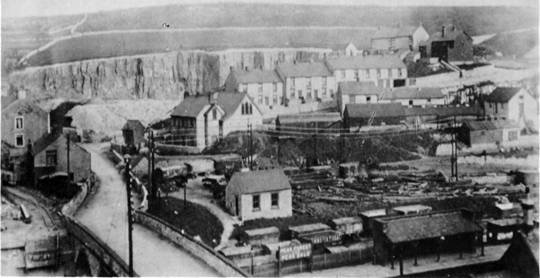
The Midland
Railway Company opened its line through Peak Dale for goods traffic on 1st
October, 1866 and for passenger
traffic on 1st February. 1867. This photograph
shows some of the extensive sidings which were built to enable local
quarrying
firms to
transport their products on the railway. Note right background loaded
waggons ready to feed stone into the crusher
built 1913.
By the 1860s
Britain already had a considerable network of railway lines. Richard
Trevithick had built the first successful
railway locomotive in 1808 and the first line
to use locomotives, the Stockton - Darlington line, engineered by George
Stephenson, had been opened in 1825. The 1840s had seen what was later to be
called "railway mania", with companies being
formed all over the country and people rushing to buy shares in
them. Although during that decade the first stages in the
development of what was to become the
Derby - Manchester route had taken place, it was a further 20 years before
the railway system reached our parish. To achieve its ambition of a
direct route between Derby and Manchester, the Midland Railway Company had
to fight the opposition of rival companies and wrestle with engineering
problems created by the difficult nature of the terrain to be crossed. The
result was a railway which, carried by numerous tunnels and viaducts through
a variety of attractive scenery, was one
of the most spectacular lines in the country.
The completed
line covered a distance of about 61 miles and carried important traffic,
much of it originating from, or bound
for, London. The line was not the work of
one company but of several completely separate companies, who constructed
sections of it at different
periods for their own reasons. The first section of the route between Derby
and Ambergate was built by the North
Midland Railway as part of their line to Rotherham via Chesterfield and was
opened on llth May, 1840. The second section of the Derby -
Manchester line was constructed by the Manchester, Buxton, Matlock and
Midland Junction Railway. This company had intended to build a line from
Cheadle, near Manchester, to Ambergate, a distance of 421/2 miles, but could
only raise sufficient capital to construct a line just 1 P/2 miles long
between Ambergate and Rowsley. It was opened
on 4th June, 1849 and in 1852 was leased
to both the Midland Railway and its rival, the London and North Western
Railway (L.N.W.R.). The Midland Railway gained control of this
section in 1871 when it was absorbed into their system.
On 4th
September, 1860, the Midland Railway Company started to build the Rowsley -
Buxton section of the line. Work on this section included the construction
of the great viaduct at Monsal Dale, tunnels near Cressbrook and Litton and
a viaduct
and station
at Millers Dale where the line entered our parish.
Chee Dale
presented many difficulties to the builders of the line. High above the
river a tunnel 430 yards long, known as
Chee Tor No. 1, was cut through a
limestone spur and. where the railway emerged from the sheer walls of the
dale, it was connected by a viaduct to
another tunnel, Chee Tor No. 2, 70 yards in length. Then for a distance of
about 400 yards the railway had to
be laid on a shelf carved out of the valley side and at the end of the ledge
passed through another tunnel. Rusher
Cutting, 94 yards in length.
A small
station was built at Blackwell Mill and it was from there that work began in
October 1863 to take the main line route
through Great Rocks Dale. The line through Wye Dale and Ashwood
Dale to Buxton became a branch line. It was opened on
1st June 1863 - the same day
that the Stockport. Disley and Whaley Bridge Railway (S.D.W.B.Railway)
opened their extension to Buxton.
This might have provided the Midland with a link to Manchester but the
L.N.W.R. was a major subscriber
to the S.D.W.B. Railway Company and was opposed to any such connection.
Instead agreement was made between the Midland Railway Company and
the Manchester. Sheffield and Lincolnshire Railway (M.S.L.R.) for the
Midland to extend its line through Great Rocks Dale to New Mills Central and
from there gain access to Manchester.
The first
part of Great Rocks Dale, deep, wooded and narrow in places, was at that
time overlooked by three farms, known as
Upper Great Rocks, Lower Great Rocks and Great
Rocks Back Pastures. From 1929 onwards this area was transformed by the
opening of Tunstead Quarry
which gradually expanded onto the meadow and pasture land occupied by those
farms. It was necessary to build two tunnels in this part of the dale. Peak
Forest Tunnel, 121 yards in length and Great Rocks Tunnel, 161
yards in length.
From the
second tunnel the railway entered the more open part of the dale, with Great
Rocks Lees rising steadily to the right
and yet another farm, Great Rocks
Pastures to the left. In Peak Dale the railway reached its highest point at
an altitude of 980 feet near to Peak Forest North signal box. Locomotives faced 15 miles of
almost constant climbing from Rowsley to the summit, the final three miles
being at a gradient of 1 in 90 and so over the years banking engines often
gave assistance to heavy trains on that section of the route.

Peak
Forest Station Staff' in July 1904. In the centre is Mr. Farrow the
stationmaster. In the late 19th century local farmers
took milk to Peak Forest and
Millers Dale Stations to be taken to Manchester:
"They used to take it half
past nine every morning. There
were
big knobs on top of the churn and they could wheel them along platform, I
can hear them now doing it. They used call it 'Milk Train'."
The station was built just before
the summit on a site near to the bridge which carries Batham Gate Road over
the railway. Although in Peak Dale it was given the name Peak Forest
Station. The most likely explanation is that at the time the area was
still referred to as Peak Forest Hamlet.
When the village became known as Peak Dale in 1893, the station retained its
old name. From the station at
Peak Dale, London was 1641/2 miles away to the south
and Manchester 251/2 miles to the north by
railway.
From the summit the railway was
taken through a very deep cutting with perpendicular walls and then entered
Dove Holes Tunnel. The great length of this tunnel, one mile and 1,224
yards, and the steepness of the gradient, again 1 in 90, resulted in the
southern portal being almost 100 feet higher than that at the northern end.
It is said that the curve of the tunnel is so slight that the opening at
each end can be seen from its centre.
The tunnel,
cut through solid limestone rock, took more than three years to complete and
caused problems for both the railway
builders and operators. Before
work on it was started it was found that a subterranean river crossed the
path of the proposed bore. As no
contractor would tender for the job, except at an expensive price, the
Railway Company decided to do the work
themselves. A long and costly drain was
cut to divert the river, but, although it flowed along the new channel for
some distance, the river suddenly
disappeared down a fissure through which it has flowed ever since. Part of
the tunnel collapsed on 19th June,
1872 just five years after it had been opened to traffic. When a workman was
killed by a locomotive in the tunnel in
1879 it was noted that trains travelled through the tunnel in just one
minute 40 seconds and later a speed restriction was
introduced on that part of the line.
From the
direction of Peak Dale the railway entered the tunnel in limestone country
but after travelling under the village of
Dove Holes it emerged in the landscape of
millstone grit surrounding Chapel-en-le-Frith. As the L.N.W.R. had chosen to
travel around the hill
through which the Midland had cut the tunnel their lines crossed at two
points. In Dove Holes the line of the
L.N.W.R. crossed that of the Midland at a height of 40 feet above the level
of the rail in the Dove Holes Tunnel. A further tunnel carried the Midland
line under the L.N.W.R. near Chapel-en-le-Frith Station. The valley of the
Blackbrook was crossed by a sandstone viaduct at Chapel Milton: beneath one
arch of this ran the Peak Forest Tramway. The line continued through
Chinley and Bugsworth to New Mills where it connected with the Marple,
New Mills and Hayfield Junction Railway. Beyond Marple the Midland
obtained running powers into Manchester (London Road) from the M.S.L.R.
Later the Midland built its own line
from New Mills to Manchester Central.
Messrs.
Campion and Langley were the resident engineers for the Midland Railway
Company and Messrs. Eckersley, Bayliss
and Ashwell were the contractors who carried out most of
the work on the 12 miles between Millers Dale and New Mills.
Some of the labourers were local
men, but the majority of the navvies came into the district from all parts
of the country and then moved on with
their work as each section of the railway was completed. From around 1861
great strain was increasingly
placed on the district's accommodation by the number of men who came to work
on the various railways. In Chapel-en-le-Frith, Sparrowpit and Dove
Holes, registered lodging houses, inns and many private households were
packed with lodgers. Eighteen houses in Dove Holes provided beds for 49
lodgers. One family of eight living in Black Hole Houses took in six
workmen, while a family of three at
Barmoor Clough took in nine men. In addition three railway huts accommodated
25 people. In the parish of
Wormhill 12 men were employed in this type of work according to the Census
Returns of 1861. Eight were described as miners, two as excavators
and two as railway labourers. Of the nine who lodged in Tunstead and
Wormhill, six stayed at the Bagshaw Arms
Inn. The number of workmen employed in making Dove Holes Tunnel was so great
that the majority of them had
nowhere to live except in whatever shelter they could make for themselves:
while working or sleeping they must have endured some of the
country's coldest weather.
Navvies were
generally regarded as rough men who often caused trouble, and during the
time they were in this area a
disturbance took place between the English and Irish
workers. Eventually the Irish were forced out of their camp and they
refused to
return until granted police protection at night. By the skilful management
of three local policemen, who were posted
outside the camp, the engineer was able to
convince the Irish that they would be protected by 36 men and the Irish
returned
reassured.
Accidents
frequently occurred when railway construction was taking place. In this area
between 1862 and 1866 at least ten
men were killed while building the railway.
The Millers
Dale - New Mills section of the line was opened for goods traffic on 1st
October, 1866. The opening of the line for
passenger traffic was delayed due to a
landslip at Bugsworth. Four hundred men worked night and day to repair the
line which was reopened for goods traffic on 24th January, 1867, and opened
to passengers on 1st February, 1867.
The Midland
route from London to Manchester via Derby and New Mills was in direct
competition with the L.N.W.R. route
via Birmingham and Stockport. Both routes covered a similar distance but
north of Derby the Midland main line suffered from
the problem
of steep gradients and so the L.N.W.R. was able to achieve faster schedules.
On the Midland Railway it took three hours and forty minutes to travel
between St Pancras and Manchester, while the L.N.W.R. completed the journey
in three and a half hours.
Sleeping car services between London and Manchester came through Peak Dale.
In 1903 the journey lasted five hours.
Other services at this time included a through express to Blackpool. A
number of the London to Manchester expresses
stopped at stations on the Ambergate -
Chinley section of the Midland main line but these stations were mainly
served by local trains.
So, from the
late 1860s, two railways and the Peak Forest Canal and Tramway could be used
by quarry owners to transport
lime and limestone out of the district. The
early history of the local quarries and works clearly shows how development
was
influenced by transport considerations.
THE QUARRIES Perseverance and Victory
The
Bibbington family worked quarries on the western side of Dove Holes Dale and
gave their name to the hamlet which grew
up nearby. A member of the family started the Perseverance
Works in about 1847. Their Victory Lime Works was opened around the time
that the Stockport, Disley and Whaley Bridge Railway extended the line from
Whaley Bridge to Buxton in
1863. A battery of lime kilns was sited alongside the railway to the south
of Dove Holes. This railway, which was taken over
by the London and North Western Railway
in 1866, also had a branch line into the quarries in Dove Holes Dale. The
Dove Holes Dale Works, which was usually referred to as Heathcott's
Quarry after the name of the owner Edward Heathcott was
served by this branch.
Wainwright's Quarry
Wainwright's
Quarry was also on the western side of Dove Holes Dale. An entry in Kelly's
Directory for 1887 shows Joseph
Wainwright as the proprietor of the Peak Forest Lime and
Stone Works, but a map of 1898 gives it the name of Peak Dale Works. A kiln
was erected in this quarry in 1876 and a simple crusher was constructed a
few years later. It is now used by
Peak Dale Youth Club Motor Cycle Club.
S. Taylor
Frith & Co. Ltd.
Almost all
the quarries on the eastern side of Dove Holes Dale were being worked by S.
Taylor Frith & Co. Ltd. by the 1920s.
The man who started the firm was Samuel
Taylor who was born in 1840. In the early 19th century his father had set up
a small
business in
Runcorn in the carrying of coal and lime by canal boat. On the death of his
father, Samuel, aged 30, took over the
business, extended it and set up as a barge
owner. He transported coal and lime from Lancashire and Derbyshire to the
tanneries and chemical
firms of Cheshire. At first he owned just one pair of "narrow boats" but as
the business prospered he added more
boats and a boat-building and repair yard until eventually he operated 24
"narrow boats", six barges or broad boats and a coasting schooner. As trade
increased he decided to make sure he could obtain a regular supply of lime
by becoming a producer and so in
1879 he bought the Holderness Quarry in Dove Holes Dale. This quarry had
been owned by Joel Carrington, a lime merchant of Hollinwood near
Oldham who had built two kilns at Holderness in the 1860s alongside the
tramway of the Peak Forest Canal Company. These kilns produced about 10,000
tons of lime a year and until Samuel Taylor could build more kilns he bought
some of the tonnages he required from Samuel Bibbington.
Samuel Taylor
extended the quarries and eventually eight kilns were in operation and a
stone crushing plant was built to
supply chemical stone, macadam and chippings. The Midland Railway lay
right in front of the Holderness Works but Samuel
Taylor
continued to use the Peak Forest Tramway as most of his customers were
alongside the canal network. Newer
industries tended to be established close to railways so a connection was
made from the quarries to the Midland Railway
around 1891. Even so, the company used the tramway until it
was closed in 1925.
In 1890
Samuel Taylor was joined by his son-in-law, James Mason Frith, who had been
the manager of the Aldershot Gas
Works. He was made a partner in
1905 and the firm became S. Taylor Frith & Co. Ltd. Mr. Arthur Frith, the
elder son of J. Mason Frith, joined the
firm in 1913. He became a director and remained on the Board until his
death, at the age of 58, in 1951.
The younger son of James Mason Frith, Mr. Frank Frith, joined the company on
his demobilisation after the First World
War. He was later made a Director and eventually succeeded his father as
Chairman and Managing Director.
When the
demand for lime and limestone increased after the First World War the
company decided to open an additional
quarry. Most of the companies operating quarries in the
district held the land under lease from the Duke of Devonshire and his
permission was sought by S. Taylor Frith & Co. Ltd. to work Bee Low Hill.
The company opened Bee Low Quarry in 1922. A
tramway operated by an endless ropeway
nearly 3/4 mile long was built to convey the
stone from the new quarry to the kilns
and crushers of the old plant. The creation
of the ropeway was a considerable achievement. It was designed by a man
named
Francis Lane, (of Lanwell Works, Brierly Hill. Staffs. ) and its
installation was the first job undertaken by Mr. Frank Frith
when he entered the business.
Newline
The Newline
and Peak quarries were taken over by S. Taylor Frith & Co. Ltd. in the 1920s. Newline
Quarry, which had opened
around 1800, was originally owned
by the Peak Forest Canal Company and from the early 1860s
horses, used on the Peak Forest Tramway,
were stabled in the quarry. Full control of the Canal Company passed to the
M.S.L. Railway Co. in 1863. This
became part of the Great Central Railway in 1897 and the Newline Quarry was
worked for ballast. When the lease
for the land expired in 1923 it was not
renewed by Great Central Railway and the Newline Quarry and the Peak Quarry
were acquired by S. Taylor Frith & Co. Ltd.
Thomas
Beswick and Sons
Thomas
Beswick and Sons were the proprietors of Small Dale Lime Works. Vertical
kilns used by this firm are on land behind
the Midland Railway Hotel. They were cut out of
the solid limestone rock and, as was usual at the time, were lined with
gritstone blocks. While poor quality local coal was used to burn lime,
gritstone was adequate for a lining, but it was unable to withstand the heat
produced by the better quality coal brought into the area. It was Mr. James
Mason Frith who, in about 1895,
introduced the use of firebricks
for the lining of lime kilns in this district.
Great Rocks
The Great
Rocks Lime and Stone Company worked a quarry from about 1864 on the eastern
side of Great Rocks Dale.
Limestone had been quarried from here since at least 1849
when the land was referred to as Limekiln and Quarry Piece and
was occupied
by Thomas Mason. The blocked drawing tunnels of the battery of kilns
belonging to Great Rocks Works can still
be seen near to the railway line at Peak Forest Station.
Stone was fed to them from the Long Siding Quarry as well as the
Great Rocks
Quarry. Six of the kilns were built in about 1869 by John Ashwell who was a
contractor in the construction of the
railway when the extension was made to the Midland line
through Great Rocks Dale. A further three kilns were added in 1876
and two more
in 1884. John Ashwell became Managing Director of the Great Rocks Lime and
Stone Company.
Bold
Venture
Peep O'Day,
Bold Venture, Gaskells, United Alkali are the various names applied to the
quarry on the western side of Great Rocks Dale. In 1849 the land was known
as Kiln Piece and was occupied by Jonathan Garlick of "The Yard", an
ancestor of Redfus and Ron Garlick who live in the village today. It seems
likely that the kiln and quarry on the land were known first of all as Peep
O'Day. The quarry was greatly extended after the building of the Midland
Railway and by 1887 it was known as
"The Bold Venture Lime Works". It was owned by
Gaskell, Deacon and Company, a chemical works which Holbrook Gaskell
had started
at Widnes in 1855. By 1899 the quarry was in the possession of the United
Alkali Company Limited which had
been formed in 1890 by the merger of 41
concerns. Bold Venture Kilns were built on the opposite side of the road to
the
quarry and a small bridge was constructed to enable stone to be taken over
the "Slack Road" to the top of the kilns. A track
across the road from the kilns into the
station yard enabled wagons to move lime to the railway and coal to the
kilns. In about
1887 a crusher
for the works was built near to the railway. Wagons ran to it from the
quarry under the small bridge which carries the footpath known locally as
"The Boardings".
Buxton
Lime Firms Co. Ltd.
Towards the
end of the 19th century the companies that had grown up were competing
fiercely for the markets for their
products. In 1891, on the initiative of H. A.
Hubbersty of the Buxton Lime Company, many of the quarry owners agreed to
come
together to form the Buxton Lime Firms Company Limited. The local firms who
joined were:-
The Great Rocks Lime and Stone Co. Ltd. Great Rocks and Long Siding
T. Beswick & Sons, Small Dale
E. Heathcott & Sons. Dove Holes
J. Wainwright, Peak Dale
Other firms involved in the merger were:-
The Old Buxton Lime Co. Ltd. Harpur Hill
The Buxton Lime Company, Grin and Whaley Bridge
The Buxton Central Lime and Stone Co. Ltd., Blackwell
East Buxton Lime Co., Millers Dale
Millers Dale and Oldham Lime Co., Millers Dale
Ashwood Dale Lime and Stone Co., Ashwood Dale
Richard Briggs & Sons, Dowlow
J. & M. Tymm, Marple
William Pitt Dixon, Bugsworth
The quarry owners who remained independent were:-
S. Bibbington, Dove Holes
Samuel Taylor, Dove Holes
Gaskell, Deacon & Co. Ltd. Bold Venture Works, Peak Dale
M. S. & L. Railway, Newline Quarry
The first
registered offices of the B.L.F. Co. Ltd. were at Burbage, Buxton, where
there were about 17 office staff and pigeons were used to maintain
communications with the works. In 1896 new premises were purchased at The
Quadrant, Buxton. These were in use until after the First World War when the
Royal Exchange building became the Head Office of the Company.
The first
directors of the Company included John Ashwell, James Beswick, Joseph
Heathcott and Joseph Wainwright and in
1894 the control of the various works was delegated to a
committee composed of those four directors. The Duchy quarry was
opened by
B.L.F. in 1899 on land owned by the Duchy of Lancaster and in 1900 South
Works was opened on Great Rocks freehold land. Perseverance, with four
kilns, was transferred to B.L.F. in 1909.
John Brunner
and Ludwig Mond had started a chemical works in Cheshire in 1872. By the end
of the First World War the
dependence of Brunner Mond & Co. Ltd. upon supplies of limestone from the
B.L.F. became so great that they
bought a
controlling
interest in the firm. As a subsidiary of Brunner Mond the B.L.F. went into
the Imperial Chemical Industries in
1926 when
Brunner Mond, United Alkali. Nobel Industries and British Dyestuffs
Corporation came together
to
form that
company.
THE WORKMEN AND THEIR FAMILIES
Men wishing to
find work in the local quarrying industry came from many different parts of
the country and gradually more houses
were built to enable their families to settle in the area. The population of
the parish of Wormhill rose from 410 in 861 to
1403 in 1901 and the number of houses from 84 to 285. This growth of
population was mainly in those parts of the parish lying in or
near Peak Dale. Many of the families came from local
villages such as Chapel-en-le-Frith. Peak Forest and Dove and
a large number came from the Staffordshire moorland villages. Others came
from further afield, from places in Lancashire, Anglesey and Northern Ireland. A study of the Census Returns shows
that few families migrated directly to the village. The Bray family arrived in the village in 1871 from
Tideswell after residing at Chapel-en-le-Frith and nearby Sparrow
Pit. The Garside family reached Upper
End from Heywood in Lancashire after living for a time in Bugsworth and
Sparrow Pit. The Mullins family
are first recorded in the 1861 Census. They came from Galway via Higher
Bebington, a sandstone quarrying
village on the Wirral.
The second
half of the 19th century saw the growth of the hamlets of Bibbington, Dove
Holes Dale and Upper End.
Bibbington
Families were living in the five
houses known as Victoria Cottages (close to Victory Quarry) by the time of
the 1861 Census. A further five newly
built houses were uninhabited. By 1871 the area had 15 houses and was known
as Lower Bibbington. Most of the
men who lived in the cottages were employed as limestone-getters,
lime-pickers or burners, but one man was an
engine driver, another a book-keeper and
one other a grocer and corn dealer. In one of the cottages lived John
Robert, a 33 year old quarryman and Wesleyan preacher, who had come from
Holyhead where large stone quarries also existed. All the
male members of the Chappell family
worked in the quarrying industry. James was a foreman at a quarry, his 13
year old son, James, was a driver
and 10 year old John was a lime-picker. Two more young labourers lived at
Lower Bibbington in 1881. Thomas
Derbyshire (aged 12) was a lime-burner labourer, half-time, at the kilns and
Frank Mellor (also aged 12) was a
labourer coal-filler, half-time.

Nineteen houses were built at Higher Bibbington between 1861 and 1871,
the occupants in 1871 included 27 men and youths
employed in the quarrying
industry. Until 1907 the Methodists in Higher Bibbington met for worship in
one of the cottages. When the congregation numbered 75, of which 40 were
children, it was decided to erect an iron building to seat about 100
people. Mr. John Wilshaw of Peak House
gave a plot of land measuring 415 square yards for the purpose of building
the Wesleyan Methodist Chapel and he asked that it be called "Longridge Lane
Chapel". Work began in the spring of 1907 and was completed four months later, the opening ceremony taking place on the 3rd July. The total cost of
the building and furnishings had
been estimated at
£ 120 but another £21 was added by the need to raise the building over a
cellar. The gift of a
pulpit came from James Salt, and
Councillor George Slater gave a harmonium.
"Praying Billy" was the nickname given to William
Bray who was a local quarryman and preacher. At "Longridge Lane" he
pounded his sermons home with great thumps on
the pulpit which often made the congregation jump. When he prayed he
began
at one end of the aisle and finished at the other. That his delivery was
simple and direct is illustrated by the story that
once, when preaching about the "Prodigal
Son". Billy Bray commented. "Would my father have killed the fatted calf for
me if I'd a done those wicked things? Not likely! You know what he'd a
done: he'd have belted my arse!"
Local men who worked hard to maintain the Chapel
included John Pheasey, Joseph Lomas and Joseph Tunnicliffe who was
Superintendent for 50 years. Two Fairfield men who did much to encourage
the work at Longridge Lane were Francis Wright
and George Slater.
Dove Holes Dale
In 1861 in Dove Holes Dale Bottom there was just one
cottage. It was sited on what is now the car park for the Midland Hotel and
in it lived Edward Cartledge, a lime-burner. By this time, on the part of
Wormhill Moor known as Sydney, Springmount Houses had been built and were
occupied by four families. Joseph Beverley. a farmer, was living in Rock
House by 1876.
The site of the Midland Railway Hotel was originally
owned by Mr. Henry Kirke of Chapel-en-le-Frith, who died in 1841. His
son
sold the land in 1866 for
£81 to a Mr.
John Fox who was a brewer. On 18th June, 1867 John Fox borrowed £900 from
Jonathan Smith of Slack Hall, who was granted all interest in the land,
including a dwelling-house, offices and outbuildings, until repayment of the
loan. Possibly that loan paid for the construction of the Midland Railway
Hotel which was granted a licence on
14th September. 1867. The property changed hands several more times before
the end of the century. On the 29th
March, 1873 the land was sold to John
Simpson Simpson (sic), a brewer. He sold the property to J. Beswick and
Sons. Lime Merchants on the 3rd August. 1886 but retained the right
to supply all "beer etc" to the tenant of the house for a period of 14
years. The following year, on 7th
January, the Midland Railway Hotel was sold to a farmer named Joseph
Stafford.
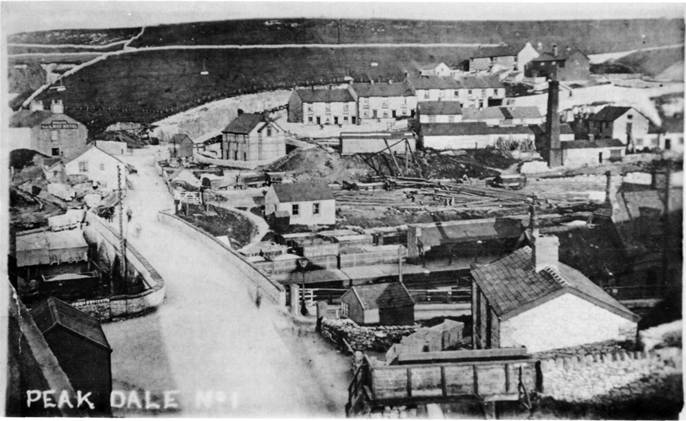
In the background from left to
right this photograph shows the Midland Railway Hotel, a small wooden hut
which was used as a butcher's shop,
Great Rocks Wesleyan Chapel, Great Rocks Row, and Pine Cottages. Stables and
workshops can be seen in front of Great Rocks Row while the building
just left of centre is remembered as the office of Mr. Morrison who was
manager of the Peak Forest quarry section of the B.L.F. The office of George
Newton, manager of Bold Venture Works, is the building
in right foreground. Note the wooden
trucks near to the entrance of the station yard. It is possible to see that
loads of limestone were moved on
rails behind the Midland Hotel and discharged into railway trucks. The
photograph dates from between 1899 when the Duchy Quarry was opened
and 1906 when the schoolroom was added to the chapel.
Dove Holes Dale Bottom in 1871
consisted of the station and stationmaster's house, the Midland Railway
Hotel and seven cottages. Joseph Woodward
was the railway stationmaster and John Clayton the innkeeper and a joiner.
The cottages were most likely those that once existed on each side of
the Midland Railway Hotel. Two were occupied by railway workers. In
another cottage Henry Brassington, a builder employing four masons and
one labourer, lived with his wife, six children and a
lodger. Solomon Wood, stonemason, had two
men as boarders, one was employed as a railway signalman, the other as a
mason's labourer.